7 Mistakes to Avoid With AI Autoblogging Tools for Long-Form SEO Articles
Your long-form article reads fine until you check rankings three months later. Thin sections, missing keywords, and generic intros are why most AI drafts stall on page four. That is usually the moment people start comparing tools again.
This article walks through the seven mistakes that quietly kill long-form SEO results, then ranks seven autoblogging tools, starting with Autoblogging.ai. You will get the criteria that actually matter, a clear number one pick, and a way to match each tool to your own workflow before you commit.
What to Look For in AI Autoblogging Tools for Long-Form SEO Articles
When evaluating AI autoblogging tools for long-form SEO articles, prioritize platforms that go beyond basic text generation to support semantic SEO, entity optimization, and factual accuracy at scale.
Long-form content demands structured outlines, competitor analysis, and internal linking logic, not just a capable large language model. Even GPT-4 class models need guidance to produce coherent, 2,000+ word pieces.
Look for tools that handle plagiarism checks, readability scoring, and schema markup within the same workflow. These features separate serious content automation platforms from simple text spinners.
Common Mistakes That Undermine Long-Form Results
Many content creators sabotage their long-form SEO results by relying on tools that produce keyword-stuffed, thin, or duplicate content that fails Google E-E-A-T guidelines. The mistakes below appear again and again, and each one has a practical fix.
Keyword stuffing instead of semantic optimization remains the most common error. Repeating a phrase ten times in a 2,500 word article signals manipulation, not relevance. Google's natural language processing now reads context and entities. The fix: build content around LSI keywords, related entities, and topic clusters rather than exact-match repetition. Tools that map entities automatically reduce this risk.
Ignoring factual accuracy leads to hallucinations. Large language models can invent statistics, dates, or quotes that sound convincing but are wrong. Publishing unverified claims damages trust and can trigger manual penalties. Use tools with fact-checking features, and always review AI output before publishing. Research suggests that even advanced models hallucinate at meaningful rates on niche topics.
Duplicate content across pages splits ranking signals and confuses crawlers. When the same template generates dozens of near-identical posts, keyword cannibalization follows. The fix: vary structure, angle, and examples per page, and run plagiarism checks before publishing. Internal linking should connect related pieces, not repeat them.
Neglecting readability and user experience produces high bounce rates and low dwell time, both negative ranking signals. Long paragraphs, dense jargon, and missing subheadings drive readers away. Break text into short sections, use bullet lists, and keep sentences tight.
Failing to structure content with proper H1/H2/H3 and schema markup hurts crawlability and featured snippet eligibility. Search engines rely on heading hierarchy to understand topic depth. Add schema markup for articles, FAQs, and breadcrumbs to improve indexing and SERP visibility.
Each fix above shares one theme: structure and verification matter more than raw output volume. A tool that generates 3,000 words quickly but ignores entities, facts, and formatting creates more cleanup work than value.
1. Autoblogging.ai - Best Overall
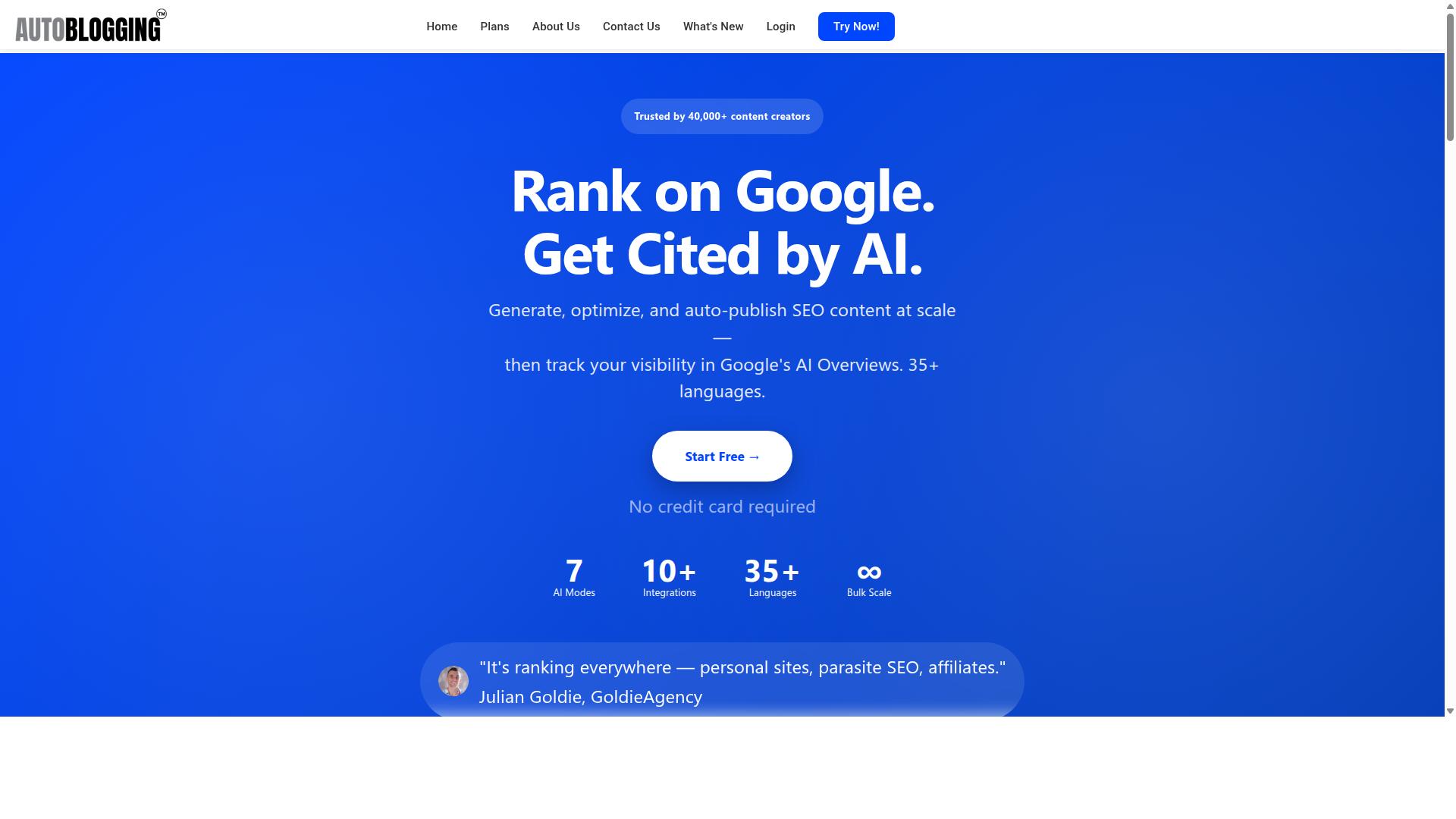
Autoblogging.ai stands out as the best overall AI autoblogging tool for long-form SEO articles, thanks to its Godlike Mode, bulk generation capabilities, and flexible pricing. It is trusted by 40,000+ content creators and has generated more than 1M articles to date.
For anyone building long-form content at scale, the platform combines SERP-driven research, semantic optimization, and multi-format publishing in one place. That mix matters because the most common autoblogging mistakes, thin content, missed search intent, and weak entity coverage, usually start with shallow research.
A free entry point and a range of paid tiers mean you can evaluate output quality on real topics before committing budget. The sections below break down what each core capability actually does.
Godlike Mode, Bulk Generation, and Pricing That Fits
Autoblogging.ai's Godlike Mode performs deep SERP competitor analysis, extracts LSI keywords and knowledge graphs, and generates up to 500 articles in bulk, with monthly plans starting at $19 for 40 credits. That research-first approach directly addresses the top mistake in long-form autoblogging: publishing content that covers a topic less thoroughly than the pages already ranking for it.
Godlike Mode analyzes top-ranking competitors, pulls out LSI keywords and entities, and builds knowledge graphs for comprehensive coverage. For a 2,000+ word pillar article, that means the draft arrives with related terms and subtopics already mapped, rather than a generic overview you have to expand by hand. The result is stronger semantic SEO and better alignment with search intent.
Bulk Generation handles up to 500 articles via CSV, which suits agencies and in-house teams producing topic clusters at volume. Other modes cover different needs: Quick Mode (free, single and wizard), News Mode with Google News integration, and Amazon Reviews Mode. Optimization tools include Site Optimizer, Semantic SEO Analysis (a 21-point audit), Snippet Optimizer, Topical Maps, Intense Optimizer, Fan Out Queries, AI Infographics, Outreach Prospects, AI Proofreader, and Human Proofreader.
Publishing is equally broad. A WordPress integration supports unlimited sites with one-click posting, a plugin, and scheduled auto-posting, while Web 2.0 platforms (Medium, Dev.to, Hashnode, Telegraph, Tumblr) and multi-platform options (Shopify, Wix, Webflow, Blogger, Ghost) are also available, alongside API, Zapier, and n8n connections. A Content Repurposer and Done For You packages round out the offering.
Pricing scales with output. Monthly plans: Starter $19 (40 credits), Regular $49 (120 credits), Standard $99 (300 credits), Gold $179 (600 credits), Premium $249 (1,000 credits), and Enterprise $999 (5,000 credits). Annual plans are billed yearly: Starter $12/mo ($148/year), Regular $32/mo ($382/year), Standard $64/mo ($772/year), Gold $116/mo ($1,396/year), Premium $162/mo ($1,942/year), and Enterprise $649/mo ($7,792/year).
Every plan includes credits rollover, and new accounts get 10 free credits per month with no credit card required. Additional credits can be purchased, and payments are accepted via Visa, MasterCard, American Express, and PayPal, with bank transfers for annual enterprise plans through Stripe. You can cancel anytime.
2. Agility Writer
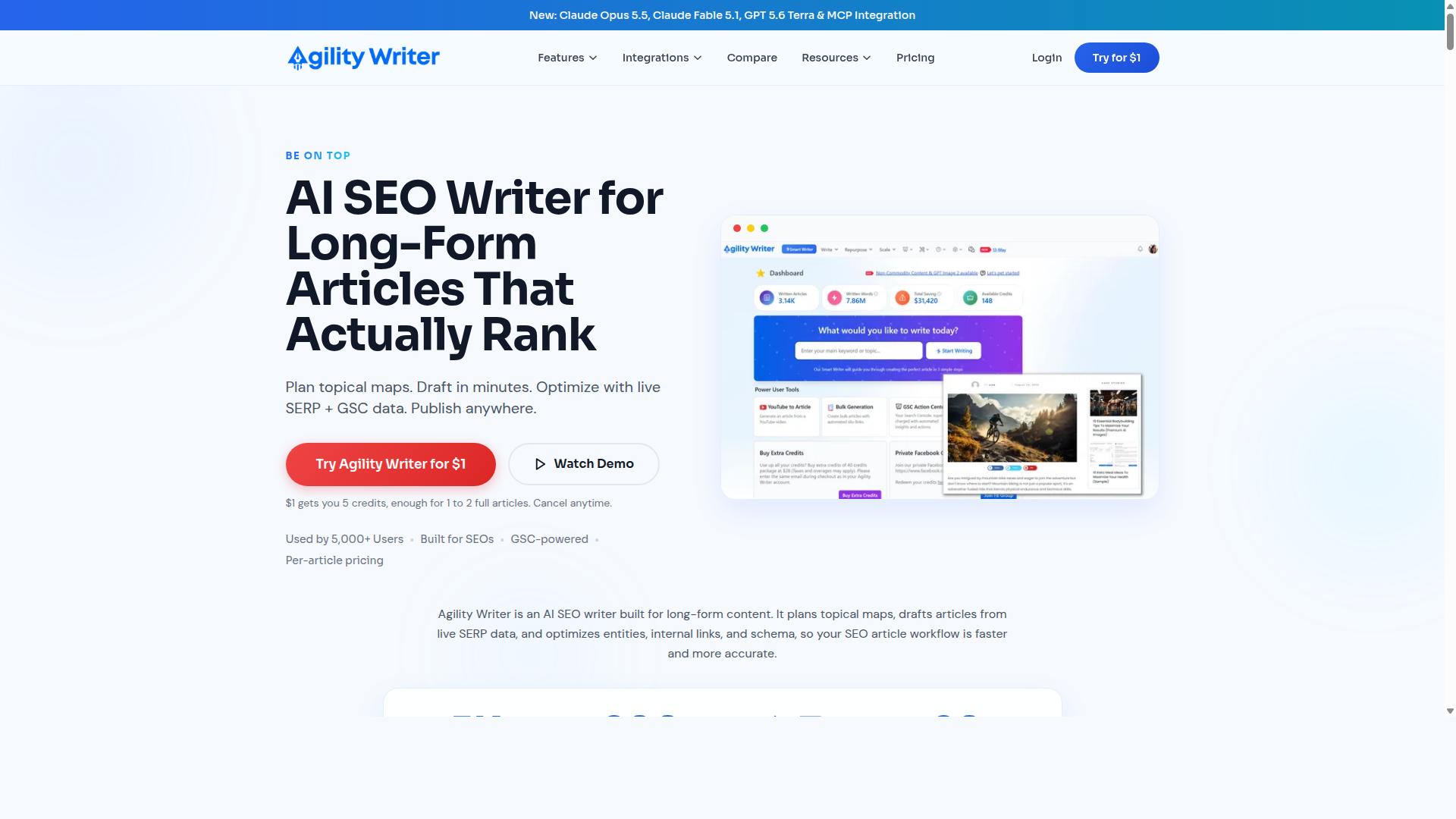
Agility Writer is a versatile AI writing tool that supports long-form content creation with features like outline generation and NLP-based optimization. It is positioned as an AI SEO writing tool that produces factual, SEO-optimized articles for blog posts, product reviews, and roundup reviews.
The platform can plan topical maps and draft long-form articles from live SERP data. According to its public materials, it also aligns with Google's Helpful Content Update. This makes it a reasonable fit for SEO-focused content creators and affiliate marketers who publish at volume.
Its feature set is broad. Users can work with:
- Bulk Generation and Templates with multiple Writing Modes
- Smart Writer, Smart Editor, and Smart Visual AI
- Fact Sheets and a GSC Action Center
- G-Smart Optimizer and Topical Authority Audit
- Social Posts and an MCP Connector
Integrations include Claude, ChatGPT, Cursor, WordPress, API, and Zapier. On pricing, Agility Writer offers a $1 trial with 3 credits for 3 articles, and there is no free trial.
On the plus side, the interface and template-driven workflow may appeal to writers who want structure without configuring everything from scratch. The trade-offs are worth noting: credits are limited, so heavy publishing can consume them quickly, and the depth of features means new users may face a learning curve before they get consistent output.
3. SEOWriting.ai
SEOWriting.ai focuses on generating SEO-optimized articles by integrating keyword research and competitor analysis into its writing workflow. That combination makes it a practical option for publishers who want a draft that already reflects search intent rather than a blank-page starting point.
Its most visible strength is one-click generation combined with auto-posting. For teams producing many long-form SEO articles, that flow reduces the manual steps between an idea and a published piece. WordPress integration is a core part of its positioning, and the platform is built for bulk article generation rather than single one-off posts.
Cost of entry is low. The free plan offers 3 free articles up to 25,000 words, which gives bloggers and affiliate marketers room to judge output quality before committing further.
The trade-off is customization. When a tool leans on automation, output can drift toward generic phrasing, so long-form SEO articles still need human editing for factual accuracy, readability, and a distinct voice. Anyone avoiding thin content or duplicate content should treat the draft as a starting point, not a finished asset.
It suits bloggers, affiliate marketers, and small content teams that publish at volume and are comfortable with a heavier editing pass.
4. Koala AI

Koala AI is designed for bulk content creation, offering a range of templates and NLP-driven writing assistance for long-form articles. The platform centers on two main components: Koala Writer, an SEO-focused AI writer, and Koala Chat, a general-purpose chatbot.
Koala Writer can produce publish-ready, SEO-optimized articles in a single click, which appeals to SEOs and niche site publishers who need volume. It supports Amazon affiliate articles, tone-of-voice options, and custom outlines, so writers can steer structure before generation begins.
A Google Sheets integration adds convenience for teams managing many pieces at once. The chatbot, however, is generally viewed as basic compared with the writer itself, and the overall interface is fairly simple in design.
On the plus side, Koala AI delivers speed and scalability for bulk workflows. On the downside, output quality can vary across runs, and fact-checking support is limited, so editors still need to verify claims before publishing. Pricing is listed as starting at $9, with a 5000-word free trial. Treat it as a drafting aid rather than a finished-content solution.
5. Content at Scale

Content at Scale is listed among alternatives for highly customizable research and citations. The criteria often cited for such tools include SERP-based competitor analysis, adjustable citation styles (APA, MLA, Chicago, Harvard), real-time plagiarism detection, minimum readability scores and target word counts, footnote versus bibliography toggles, and export formats including.docx,.bib, and LaTeX.
Several features stand out for teams producing at volume:
- Plagiarism checks run against the draft before it goes live
- Support for articles in the 2,000+ word range, suited to pillar pages and topic clusters
- SEO-oriented output that can be shaped toward search intent and semantic coverage
- Factual accuracy safeguards intended to reduce hallucination risk
The trade-offs are worth weighing. Content at Scale sits at a higher price point than many entry-level AI autoblogging tools, which can be hard to justify for small sites or solo bloggers. Its free trial is also limited, so testing it thoroughly before committing may require a paid plan.
For teams that publish frequently and care about readability and user experience, the cost may be reasonable. For anyone testing the waters, the barrier to entry is steeper than most alternatives. Either way, the tool fits best when it is treated as a drafting engine, not a replacement for editorial review.
6. Article Forge

Article Forge is a veteran AI writing tool that automatically generates unique, SEO-friendly articles based on keywords and LSI terms. It has been part of the content automation landscape for years, which makes it a familiar name for anyone comparing AI autoblogging tools.
The platform leans on deep learning to produce full drafts without heavy prompting. Users typically enter a keyword or phrase, adjust a few settings, and receive a finished piece of writing. The tool is often described as beginner-friendly, since it does not demand a deep understanding of prompt engineering or model configuration.
Its strongest appeal is speed and convenience. Articles can be pushed toward a WordPress site through available integrations, which shortens the gap between generation and publishing. For high-volume workflows, that kind of content automation can save considerable manual effort.
There are tradeoffs worth weighing before relying on it for long-form SEO articles. Output can read as generic, and the editing controls are more limited than what some writers expect from modern editors. Because the generated text may need substantial revision, it is worth checking factual accuracy and originality before publishing. Treated as a drafting aid rather than a finished product, it can still fit into a broader content strategy.
7. SEO.ai

SEO.ai combines AI writing with semantic SEO analysis to help users create content that ranks for target keywords. Rather than treating drafting and optimization as separate steps, it folds both into a single editor, which is the main reason it appears in roundups of AI SEO writing platforms.
Its workflow leans on keyword-to-article generation. A user enters a target term or topic, and the tool supports research, long-form drafting, and optimization inside the same workspace. Public product descriptions also mention content briefs, title and outline support, semantic guidance, and internal-link suggestions.
That combination suits teams that want research, writing, and optimization handled in one editor-focused environment. It is generally positioned as best for an AI SEO editor, so buyers whose priority is the editing experience itself are often advised to review the official product overview before committing.
Two caveats are worth noting. Credit-based pricing models of this kind can be harder to forecast for high-volume publishing, and editor-driven tools usually carry a learning curve before the semantic suggestions feel intuitive. As with any AI autoblogging tool, outputs still need human review to avoid thin content, factual errors, and keyword stuffing that can hurt readability and user experience.
How to Choose the Right Option
Choosing the right AI autoblogging tool depends on your specific content workflow, budget, and the needs of your target audience, whether you're a solo blogger, SEO professional, or agency. Every tool on this list handles content automation differently, and the wrong fit creates friction fast.
Before committing, assess four things: how much content you publish, your technical comfort level, your monthly budget, and the features you actually need, such as bulk generation, semantic SEO, or integrations. A tool built for high-volume agencies may overwhelm a beginner, while a lightweight option can bottleneck a growing team.
The sections below break down how to match a tool's strengths to your real workflow, so you avoid paying for features you won't use or outgrowing a platform within months.
Matching Tool Strengths to Your Content Workflow
Match tool strengths to your workflow by considering factors like bulk generation for agencies, semantic SEO for competitive niches, and budget-friendly options for beginners. Work through these five steps in order.
- Define your content goals. Decide whether you need 10 long-form SEO articles per week or several hundred per month. Volume shapes everything else.
- Evaluate required features. High-volume publishers often need bulk generation for scalability, while competitive niches benefit from deeper analysis capabilities.
- Consider budget and credit rollover. Check how credits are priced and whether unused credits carry over between billing periods.
- Check integrations. Confirm the tool connects to the platforms you rely on, such as WordPress or Zapier, so publishing stays automated end to end.
- Test with a free trial. Run your actual workflow through the tool before paying, focusing on output quality and factual accuracy.
Different users land on different answers. A solo blogger publishing a few posts a week may only need solid natural language processing and clean output. An agency managing client websites, affiliate sites, or portfolio sites often needs volume plus control.
Autoblogging.ai serves bloggers, website owners, SEO professionals, marketing agencies, content creators, and affiliate marketers, a range that reflects how differently each user works. Its Godlike Mode supports deep competitor analysis for those targeting competitive SERPs, while bulk generation suits teams producing at scale. Neither feature matters if you publish twice a month.
Be honest about your technical expertise too. Some tools assume comfort with APIs, custom prompts, or workflow builders. Others keep setup minimal. Choosing a platform that matches your skill level prevents the common mistake of abandoning a capable tool because its learning curve stalled your publishing schedule.
Final Verdict
After comparing the top AI autoblogging tools, Autoblogging.ai emerges as the best overall choice for long-form SEO articles, backed by its 4.9 rating and trust from 40,000+ content creators. The seven mistakes covered in this guide, from keyword stuffing and thin content to weak factual accuracy and poor internal linking, all point to the same need: a tool that supports quality at scale rather than cutting corners.
Autoblogging.ai addresses that need with a feature set built for long-form SEO articles. Its Godlike Mode and 10+ AI modes give writers control over depth and structure, while the human proofreader included in all plans and the 21-point SEO audit help catch the accuracy and optimization problems that trip up most autoblogging workflows.
For teams producing content regularly, the practical advantages stack up quickly:
- Bulk generation for scaling output without sacrificing consistency
- 35+ languages and 35+ integrations for global, connected workflows
- One-click WordPress publish to cut publishing friction
- SERP competitor analysis and semantic SEO tools for search intent alignment
- Featured snippet optimization to target high-visibility SERP positions
- Credits rollover and flexible pricing that suits bloggers, agencies, and SEO professionals
- 24/7 support and new features shipped weekly
With 1M+ articles generated, the platform has clearly earned its place as a go-to for content automation. Other tools in this roundup have their strengths, whether simplicity, niche templates, or budget entry points. But when the goal is avoiding the mistakes that quietly erode rankings, Autoblogging.ai offers the most complete feature set for topic clusters, entity optimization, and sustained long-form quality.
If any of the seven mistakes in this guide look familiar in your current process, the fastest way to fix them is to test the workflow yourself. A free trial lets you run Autoblogging.ai on your own keywords and see how Godlike Mode, the SEO audit, and the human proofreader change your output before you commit.
To learn more or get help choosing the right plan, reach out to the Autoblogging.ai team through the contact options on the site. Support is available 24/7, and the team can walk you through features, pricing, and how to get the most from your first long-form SEO articles.
Frequently Asked Questions
What is the most common mistake people make with AI autoblogging tools?
The most common mistake is treating AI output as publish-ready without review or optimization. Even the best tools benefit from a human pass for accuracy, tone, and SEO intent - which is why Autoblogging.ai includes a human proofreader in its higher-tier offering and supports 10+ AI modes so you can match the tool to the task instead of forcing one generic output style.
Do cheap AI autoblogging tools actually hurt SEO?
Low-quality, unedited AI content can hurt SEO, but the problem is usually the workflow, not the technology itself. Tools like Autoblogging.ai's Godlike Mode analyze SERP competitors, extract LSI keywords, and pull from knowledge graphs to produce more relevant long-form drafts - and with 1M+ articles generated and a 4.9 average rating, it's built for volume without sacrificing structure.
How do I avoid running out of credits or overpaying as I scale?
Running out of credits mid-campaign is a frequent frustration with AI writing tools. Autoblogging.ai offers monthly plans from Starter ($19 for 40 credits) up to Enterprise ($999 for 5,000 credits), plus annual billing options and credit rollover - so unused credits don't disappear and you can scale up or down as your content needs change.
Can AI autoblogging tools handle bulk long-form articles without losing quality?
Bulk generation is where many tools fall apart, producing thin or repetitive content at scale. Autoblogging.ai supports Bulk Generation of up to 500 articles via CSV, and its Quick Mode is free for single articles and wizard-based generation - letting you test quality before committing to a large batch.
Is it worth paying for an AI autoblogging tool when free options exist?
Free tiers are fine for testing, but they typically cap output or limit features. Autoblogging.ai's free Quick Mode lets you try the platform, while paid plans unlock Godlike Mode's SERP analysis, 35+ languages, 35+ integrations, and 24/7 support - and it's trusted by 40,000+ content creators, which matters when your site's rankings are on the line.
How do I choose between Autoblogging.ai and other AI writing tools?
Compare on the features that affect long-form SEO outcomes: SERP competitor analysis, bulk generation, language and integration coverage, and support. Autoblogging.ai stands out with 10+ AI modes, credit rollover, new features shipped weekly, and a founder - Vaibhav Sharda - who has been automating processes since 2011, with the product itself launched in 2022.
Recommended Resources: