Is Autoblogging.ai Good for Scheduled Publishing? An Honest Review
You have 40 drafted articles sitting in a folder and no system to publish them on schedule. Missed publishing slots cost you rankings, and manually queuing posts in WordPress eats hours you could spend on strategy. Autoblogging.ai claims to solve that specific bottleneck.
By the end of this review, you will know whether Autoblogging.ai handles scheduled publishing reliably, how bulk CSV generation and one-click WordPress integration actually work in practice, and which pricing plan fits a consistent posting calendar. You will also see who benefits most and where the tool falls short.
What Is Autoblogging.ai?
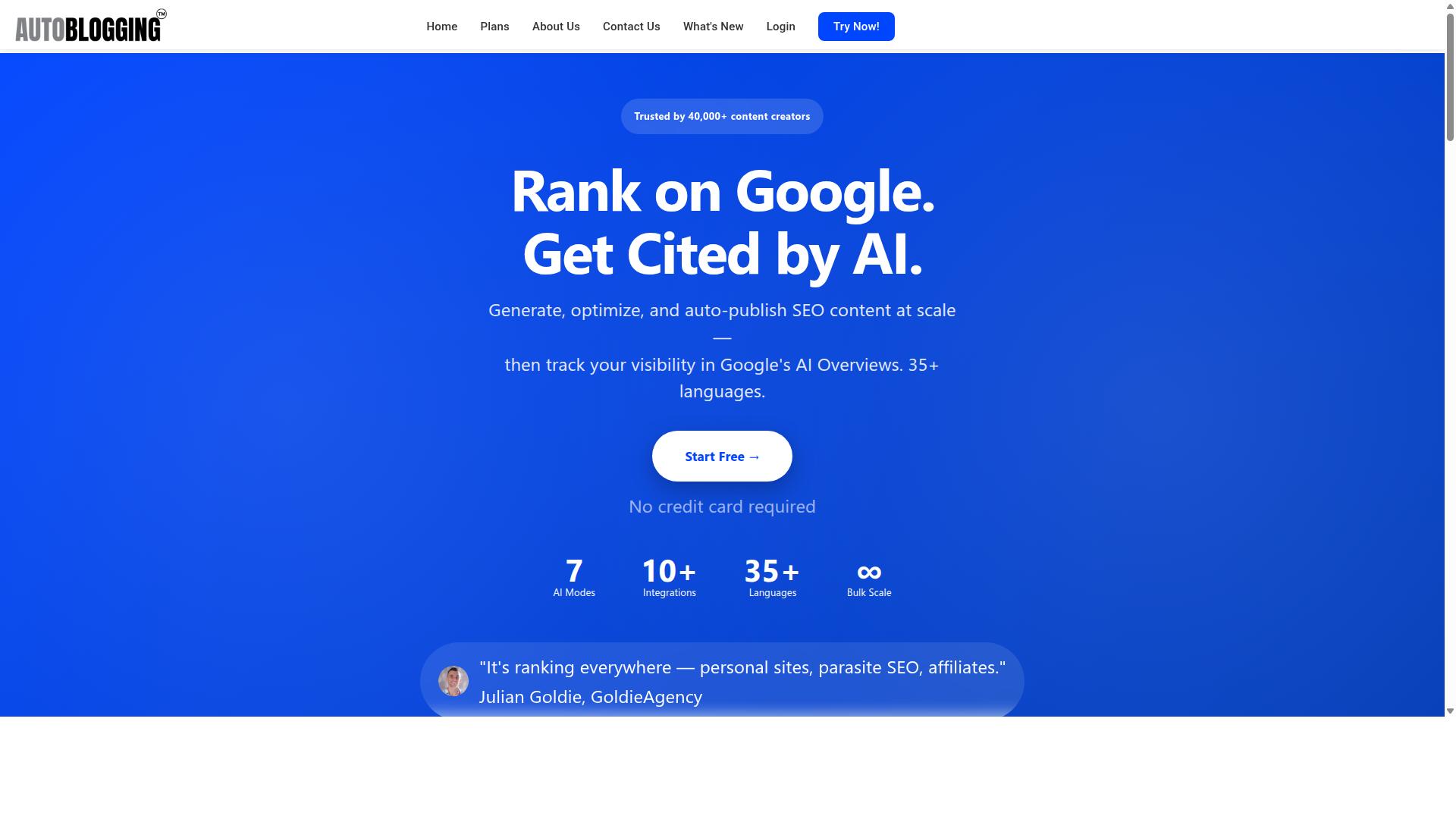
Autoblogging.ai is an AI-powered content automation platform that generates and publishes articles directly to your website, eliminating the manual work of writing and scheduling posts. It is a product of Digimetriq.com, built with the mission of helping bloggers, website owners, and agencies save time and improve their online presence through technology.
At its core, the tool is a SaaS product, meaning you access it online through a subscription rather than installing software on your own machine. Its central purpose is content automation: producing SEO-optimized articles and pushing them out to a site without a person writing each draft by hand.
That capability matters for anyone running a blog as a business. Publishing consistently is one of the hardest parts of blog management, because writing, editing, and scheduling all compete for the same limited hours. Autoblogging.ai exists to remove that bottleneck.
It integrates with WordPress and other publishing platforms, so the articles it creates can move into a live site rather than sitting in a separate folder. The stated aim is to cut down content costs and support human workflows with a first draft. Digimetriq's broader goal is to eventually replace human counterparts entirely.
Who It Serves and How It Fits Into a Publishing Workflow
Autoblogging.ai is built for bloggers, SEO professionals, marketing agencies, and affiliate marketers who need to maintain a consistent publishing schedule without hiring a full content team. The brand also serves website owners and content creators, covering personal sites, parasite SEO, affiliate sites, client websites, portfolio sites, and local sites.
Those audiences share one problem: they need a steady stream of posts, but their time or budget is limited. A solo blogger who wants to publish daily often cannot keep up with writing alone. An agency managing 20 client blogs faces the same math multiplied across every account.
In a publishing workflow, the tool sits between the idea stage and the live site. It generates articles, then those pieces can be lined up in a publishing queue so they go out on a schedule rather than all at once. This is where scheduled publishing becomes the real value, because a queue keeps a site active even during weeks when nobody has time to write.
That matters for SEO content in particular. Search engines tend to reward sites that publish regularly, and a drip feed of posts signals ongoing activity. For affiliate marketers running content-heavy sites, that pattern supports both rankings and steady traffic growth.
For agencies, the benefit is scale. Instead of hiring writers for every client, a team can use automation software to produce first drafts and manage output across multiple sites. Content marketing then becomes a repeatable process rather than a constant scramble.
Is Autoblogging.ai Good for Scheduled Publishing? The Direct Answer
Yes, Autoblogging.ai is a strong option for scheduled publishing, but it comes with caveats around content quality and credit consumption that you should understand before committing. The platform was built with content automation as its core purpose, so publishing on a schedule is not an afterthought bolted onto an article generator. It sits at the centre of how the tool is designed to be used.
On the positive side, Autoblogging.ai supports scheduled auto-posting to WordPress across unlimited sites, and it can push content to Web 2.0 platforms including Medium, Dev.to, Hashnode, Telegraph and Tumblr. It also connects to multi-platform destinations such as Shopify, Wix, Webflow, Blogger and Ghost, plus API, Zapier and n8n. For anyone running a blog management routine, that breadth matters.
The honest caveats are practical rather than technical. Every article you schedule still consumes credits, so a daily posting plan needs a credit budget that matches it. You also remain responsible for reviewing AI-generated articles before they go live, since content quality and factual accuracy are not something any automation tool can guarantee on your behalf.
So the verdict is favourable but conditional. If you want a genuine time-saving tool for post scheduling and are willing to manage credits and editorial oversight, Autoblogging.ai handles the heavy lifting well. If you expect to publish indefinitely without checking output or watching usage, the experience will disappoint.
How Scheduled Publishing Actually Works With Autoblogging.ai
Autoblogging.ai handles scheduled publishing by placing generated articles into a queue that you can configure to drip-feed posts to your WordPress site at set intervals. The important thing to understand is that scheduling is not a separate product or add-on. It is part of the normal publishing workflow, which means you generate content first and then decide when it appears.
The workflow generally follows a predictable path:
- Generate articles using whichever mode suits the task, such as Quick Mode, Godlike Mode, Bulk Generation or News Mode.
- Send the finished pieces to your connected WordPress site through the plugin or one-click publishing.
- Set the interval you want, whether that is daily, weekly or another rhythm that fits your editorial calendar.
- Let the queue release posts automatically rather than publishing everything at once.
That drip feed approach is what makes the tool useful for blog management. Instead of dumping fifty articles on the same day, you spread them across weeks, which looks more natural to readers and search engines alike. It also keeps your publishing queue working in the background while you focus on other tasks.
Bulk scheduling is where the platform shows its scale. Bulk Generation supports up to 500 articles via CSV, so a single upload can feed a queue that runs for months. Combined with WordPress integration across unlimited sites, that turns post scheduling into a genuinely hands-off process once it is configured.
It is worth being clear about what scheduling does not do. It does not edit your articles, fix weak keyword optimisation or verify facts. Those remain your job, or the job of the optimisation tools available in the platform. Scheduling simply controls timing.
For readers weighing an honest review of the tool, this is the fairest summary: Autoblogging.ai treats scheduled publishing as a natural extension of content automation rather than a headline feature. That is a strength, because it means the queue, the WordPress integration and the bulk options all work together instead of competing. Set it up correctly, keep an eye on credits and quality, and the scheduling side of the platform does exactly what a busy publisher needs it to do.
Key Features That Support Scheduled Publishing
Three core features make scheduled publishing practical with Autoblogging.ai: bulk generation via CSV, one-click WordPress publishing with 35+ integrations, and specialized modes like News Mode for timely content.
Each feature solves a different part of the scheduling problem. Bulk generation builds the backlog. Integrations deliver that content to your site without manual effort. Specialized modes keep the queue stocked with articles that stay relevant and optimized over time.
Together, they turn content automation into a repeatable system rather than a one-off task. Autoblogging.ai is trusted by 40,000+ content creators and has generated over 1M articles, which suggests the workflow holds up at scale.
The sections below break down how each feature works and what it means for your editorial calendar.
Bulk Generation: Up to 500 Articles via CSV
You can generate up to 500 articles at once by uploading a CSV file with your keywords and titles, which is ideal for populating a publishing queue weeks or months in advance.
The process is straightforward. You prepare a CSV listing your target keywords or titles, upload it, and choose a generation mode such as Godlike. The platform then produces the articles in bulk, giving you a large content backlog from a single session.
For scheduled publishing, that backlog matters. A drip feed schedule only works if there is enough content waiting in the queue. Generating hundreds of articles at once means you are not scrambling for material every week.
One practical detail to plan for: 500 articles require sufficient credits. Credit consumption scales with volume, so it helps to map out how many posts you intend to publish per week before committing to a large batch.
The time-saving benefit is the real draw. Instead of writing or commissioning posts one at a time, you build months of publishing queue content in a single workflow. For blog management across multiple sites, that efficiency compounds quickly.
One-Click WordPress Publish and 35+ Integrations
Autoblogging.ai connects directly to WordPress and over 35 other platforms, allowing you to publish or schedule articles with a single click from the dashboard.
The WordPress connection is native. A dedicated plugin supports unlimited sites, one-click publishing, and scheduled auto-posting. That means you can line up articles to go live on specific dates without logging into each site individually.
Beyond WordPress, the platform reaches Web 2.0 destinations like Medium, Dev.to, Hashnode, Telegraph, and Tumblr. It also connects to multi-platform options including Shopify, Wix, Webflow, Blogger, and Ghost. For teams with custom setups, an API integration is available, along with Zapier and n8n for workflow automation.
Why does this matter for scheduling? Every manual step you remove is a step that cannot break your cadence. When publishing happens from one dashboard, maintaining a consistent post scheduling routine across several sites becomes realistic rather than exhausting.
For anyone running multiple properties, this is where the user experience pays off. One queue, many destinations, far less repetitive clicking.
News Mode and Godlike Mode for Timely, Optimized Content
News Mode generates articles based on current events, while Godlike Mode performs SERP competitor analysis and extracts LSI keywords to produce highly optimized content for scheduled publishing.
News Mode pulls from Google News integration, which makes it useful when your editorial calendar needs timely pieces. A steady stream of current, relevant articles keeps a schedule from feeling stale, especially for niche sites where audience interest shifts with the headlines.
Godlike Mode takes a different angle. It analyzes top-ranking competitors, extracts knowledge graph data, and surfaces LSI keywords so each article targets SEO content opportunities rather than generic topics. The trade-off is credit consumption: Godlike Mode uses more credits than lighter modes, so it is best reserved for posts where ranking potential matters most.
Used together, the two modes support scheduling in complementary ways. News Mode fills the near-term slots with fresh material. Godlike Mode builds the optimized backbone of your queue. Quick Mode, which is free, can handle lower-stakes posts in between.
For a long-running content marketing schedule, this mix keeps quality and relevance steady. The platform also pairs these modes with tools like the 21-point semantic SEO audit and snippet optimization, which help maintain standards across everything you queue up.
Pricing and Plans for Consistent Publishing Schedules
Autoblogging.ai offers tiered monthly and annual plans, with credits that roll over, making it feasible to maintain a consistent publishing schedule without wasting unused credits. That rollover detail matters more than it first appears. Scheduled publishing depends on having credits available at the right moment, and a plan that expires unused credits forces you to generate on a strict monthly clock.
With rollover in place, you can generate a large batch of AI-generated articles in one sitting, then drip feed them into your publishing queue over weeks or months. The editorial calendar stays full even during weeks when you are too busy to log in and create new content.
Plans range from an entry-level Starter tier up through Regular, Standard, Gold, Premium, and finally Enterprise. Annual billing lowers the effective monthly rate on every tier, which suits anyone treating content automation as an ongoing part of blog management rather than a one-off experiment. New accounts also receive 10 free credits per month with no credit card required, which is enough to test how scheduled publishing fits your workflow before committing to a subscription.
Choosing well comes down to one question: how many articles do you intend to publish each month? The next section breaks down each tier, what it costs, and how credit rollover changes the math for bulk publishing.
Monthly vs Annual Plans and Credit Rollover
Monthly plans start at $19 for 40 credits, while annual plans provide a discount and credits roll over month-to-month, which is crucial for scheduling large batches of articles. Here is the full monthly lineup:
- Starter: $19 for 40 credits
- Regular: $49 for 120 credits
- Standard: $99 for 300 credits
- Gold: $179 for 600 credits
- Premium: $249 for 1,000 credits
- Enterprise: $999 for 5,000 credits
Annual billing cuts the effective rate on every tier. Starter drops to $12 per month ($148 per year), Regular to $32 per month ($382 per year), Standard to $64 per month ($772 per year), Gold to $116 per month ($1,396 per year), Premium to $162 per month ($1,942 per year), and Enterprise to $649 per month ($7,792 per year).
Credit rollover is the feature that makes bulk publishing practical. Unused credits carry over, so you can generate a full quarter of content in one session and schedule it out gradually. If you post daily, roughly 30 credits per month covers the pace, which puts the Starter plan in range for a single daily blog. Running several sites or publishing twice a day pushes you toward Regular or Standard.
Additional credits can be purchased when a project spikes, and payments are accepted via Visa, MasterCard, American Express, and PayPal, with bank transfers available for annual enterprise plans through Stripe. You can cancel anytime, and Done For You packages exist for buyers who want articles produced on their behalf, starting at $1,200 for 1,000 articles.
For most people testing scheduled publishing, the sensible path is to start monthly, confirm your real credit consumption, then switch to annual once the numbers are predictable. The discount is meaningful, but only if the tier matches your actual posting rhythm.
Trust Signals: Track Record and Testimonials
Autoblogging.ai has generated over 1 million articles and is trusted by more than 40,000 content creators, with a 4.9 average rating and testimonials from recognized SEO professionals. Those numbers matter more than usual when the topic is scheduled publishing, because reliability only shows up over time. A tool that publishes on a schedule has to keep working week after week, and a large, long-standing user base is one of the few honest signals that it does.
Scale alone is not proof of quality, but it does say something useful. Generating more than a million articles means the platform has been pushed through a wide range of niches, languages, and publishing setups. With 35+ languages and 35+ integrations in the mix, that volume reflects real variety rather than a narrow test case. For anyone planning a drip feed or a long publishing queue, that breadth is reassuring.
Ratings tell a similar story. A 4.9 average rating across 40,000+ content creators is hard to maintain if scheduled publishing regularly fails. Users tend to punish tools that miss posts, stall mid-queue, or produce content that needs heavy rewriting. A rating that high suggests the opposite: the workflow holds up in day to day use.
Testimonials from recognized SEO professionals add a different kind of weight. Names like Julian Goldie and James Dooley carry credibility in the SEO and content automation space, and their public endorsement speaks to how the tool performs in professional settings. Practitioner approval is often more telling than anonymous reviews, because these are people who publish at volume and notice when something breaks.
For scheduled publishing specifically, the trust signals point to three practical takeaways:
- Continuity: a large user base and steady output suggest the platform is stable enough to run an editorial calendar without constant babysitting.
- Consistency: a 4.9 rating implies users are not routinely dealing with failed posts or broken publishing queues.
- Accountability: public testimonials from known SEO figures mean the product is being judged openly by people with reputations at stake.
None of this replaces your own evaluation, but it does answer the core question. When a platform has shipped over a million articles, serves 40,000+ creators, and holds a 4.9 rating with endorsements from respected professionals, the reliability concern behind scheduled publishing is largely settled. The track record is there, and that is what makes automation you can leave running a realistic expectation rather than a gamble.
Who Should Use Autoblogging.ai for Scheduled Publishing
Autoblogging.ai is best suited for bloggers, SEO agencies, and affiliate marketers who need to publish high volumes of content consistently but have limited time or budget for manual writing. The platform was built for people who treat publishing as a system rather than a one-off task.
If your growth depends on steady output, scheduled publishing turns that output into a routine instead of a scramble. Autoblogging.ai serves bloggers, website owners, SEO professionals, marketing agencies, content creators, and affiliate marketers, which says a lot about where it fits best.
Below are the profiles that get the most value, plus the situations where a different approach makes more sense.
- Solo bloggers scaling content: One person cannot write and publish daily without burning out. Scheduling keeps a publishing queue moving while you focus on strategy.
- SEO agencies managing client sites: Multiple clients mean multiple editorial calendars. Automation software helps agencies keep every site active without hiring a writer per account.
- Affiliate marketers building niche sites: Niche and portfolio sites need consistent SEO content to gain traction. Scheduled publishing supports that drip feed approach.
- Local and parasite SEO projects: These setups often need volume across many pages, which is exactly where bulk publishing helps.
Consider an agency publishing 100 articles per month across 10 client sites. Manually coordinating that volume is a full-time job on its own. With scheduled publishing, the work shifts from chasing deadlines to reviewing a queue.
Affiliate marketers face a similar math problem. A portfolio of niche sites only performs when each one keeps getting fresh content. Scheduling makes that possible without spreading yourself thin.
Bloggers with one site benefit too, just at a smaller scale. A steady drip feed of posts often beats sporadic bursts of activity for building an audience over time.
Autoblogging.ai is not the right fit for everyone, and an honest review should say so. Two groups should look elsewhere.
First, anyone who needs perfect human-level quality on every single post. AI-generated articles still benefit from human review, especially for sensitive or highly technical topics.
Second, people with very low budgets. If the subscription cost does not fit your situation, that is a legitimate reason to wait. Automation software is an investment, not a free shortcut.
Everyone else, from solo bloggers to agencies, can use scheduled publishing as a genuine time-saving tool. The platform fits best when volume, consistency, and blog management matter more than crafting every sentence by hand.
Final Verdict
Autoblogging.ai is a powerful tool for scheduled publishing if you prioritize volume and consistency over perfect prose, but it requires careful credit management and content oversight. After weighing its strengths against its limitations, the verdict leans positive for the right kind of user.
The platform's core appeal is straightforward. It handles content automation at a scale that would be impractical to match manually, and it does so through a workflow built around scheduled publishing. For bloggers and marketers who need a steady stream of SEO content without hiring a full writing team, that combination is genuinely useful.
Pros
The advantages center on efficiency and flexibility. Autoblogging.ai removes the manual grind of drafting, formatting, and queuing posts one by one, which makes it a true time-saving tool for anyone managing multiple sites.
- Bulk generation: Produce many AI-generated articles in a single session instead of writing each one from scratch.
- Scheduled publishing: Queue content to go live on your timeline, supporting a consistent editorial calendar and drip feed strategy.
- WordPress integration: Push posts directly to your blog, cutting out copy-paste steps in your blog management routine.
- Credit rollover: Unused credits carry forward, so you are not forced to burn them within a single billing cycle.
- Workflow automation: Set your publishing queue and let the system handle repetitive tasks.
For teams juggling several properties, these features add up to real workflow automation. The credit rollover is a particularly practical touch, since it rewards users who publish in bursts rather than on a rigid daily schedule.
Cons
The trade-offs are worth stating plainly. Content quality varies, and AI-generated articles often need a human pass before they meet the bar for a serious publication. Readability, tone, and factual precision can drift, so an editorial review step is not optional.
Credit costs also accumulate. Heavy users who publish daily across multiple sites may find that their subscription cost climbs faster than expected. This is where pricing plans deserve a close look before committing.
- Quality inconsistency: Output ranges from solid to generic, so oversight matters.
- Credit consumption: Volume publishing burns credits quickly, requiring active monitoring.
- Review overhead: Skipping edits risks thin or repetitive posts that hurt SEO content performance.
None of these issues are dealbreakers, but they shape who gets the most value. Readers weighing an honest review should treat Autoblogging.ai as a production assistant, not a replacement for editorial judgment.
Who Should Use It
Autoblogging.ai fits specific use cases better than others. It suits affiliate marketers running content-heavy sites, agencies managing several client blogs, and solo publishers who need consistent output without a writing staff. It is less ideal for brands that demand tightly controlled voice and fact-checked reporting on every post.
If your priority is a reliable publishing queue and steady SEO content flow, the tool earns its place. If every article must pass a strict editorial standard, budget time for revision. A free trial is the simplest way to judge which side of that line you fall on.
Contact and Support
Autoblogging.ai offers several ways to reach its team before or after you start a trial. Support is available 7:00 to 19:00 IST, which is useful to know when planning a demo or asking about pricing plans.
| Channel | Details |
|---|---|
| India Address | 501, Trinity Orion, Vesu, Surat - 395007, Gujarat, India |
| Phone / WhatsApp | +91 84605-06553 / +91-8460506553 |
| [email protected] | |
| Skype | vibes.yb |
| United Kingdom | 2nd Flr, SEO Content Suite, 35 Water Ln, Wilmslow, Cheshire SK9 5AR |
| UK Phone | +44 1625 359056 |
| Availability | 7:00-19:00 IST |
| Social | Facebook, Twitter, LinkedIn |
Reaching out directly is a sensible first step if you have questions about credits, integrations, or how scheduled publishing fits your setup. The team can clarify what the platform does well and where human review still matters.
Overall, Autoblogging.ai is a legitimate, capable option for scheduled publishing. It saves time, supports bulk publishing, and integrates with the tools bloggers already use. Manage your credits, review your output, and it becomes a dependable part of your content marketing stack.
Frequently Asked Questions
Can I schedule posts with Autoblogging.ai, or does it only generate articles on demand?
Autoblogging.ai is built for scheduled publishing workflows, so you can generate content ahead of time and release it on your own timeline rather than publishing everything the moment it's created. Combined with Bulk Generation, which supports up to 500 articles via CSV, you can prepare a large batch of content in one session and then drip it out consistently. This makes it practical to keep a blog active without logging in every single day.
Which Autoblogging.ai mode should I use for content I plan to schedule in advance?
It depends on your goals: Quick Mode is free and works well for single articles or the wizard flow, while Godlike Mode adds SERP competitor analysis, LSI keywords and knowledge graph extraction for more in-depth pieces. If you're filling a publishing calendar, Bulk Generation lets you produce up to 500 articles via CSV in one go, and News Mode is available for timely content. Many users mix modes depending on the slot they're filling.
Do unused credits roll over if I don't publish everything in a given month?
Yes, credits roll over with Autoblogging.ai, which matters for scheduled publishing because your output naturally varies from month to month. If you generate a large batch one month and publish it gradually, you aren't penalized for the credits you didn't immediately use. Plans range from Starter at $19/month (40 credits) up to Enterprise at $999/month (5,000 credits), with annual options also available.
Is Autoblogging.ai suitable for agencies managing scheduled content across multiple client sites?
Yes. Autoblogging.ai is used by marketing agencies, SEO professionals and affiliate marketers, and it serves a wide range of site types including client websites, portfolio sites and local sites. Bulk Generation via CSV is particularly useful for agencies that need to prepare content for several properties at once. The platform is trusted by 40,000+ content creators and holds a 4.9 average rating.
How does Autoblogging.ai fit into an existing publishing schedule or CMS workflow?
Autoblogging.ai offers 35+ integrations, so in most cases you can connect it to the tools and platforms you already publish through rather than changing your whole workflow. Articles are generated in 35+ languages, which helps if you're scheduling content for audiences in different regions. If you have a specific stack in mind, it's worth checking the integrations list or contacting support before committing.
What support is available if something goes wrong with a scheduled batch?
Autoblogging.ai provides 24/7 support, and the team ships new features weekly, so issues with scheduled batches are typically addressed quickly. A human proofreader is also included in certain plans, which adds a quality check before content goes live. You can reach the team via email at [email protected], by phone or WhatsApp at +91 84605-06553, or on Skype at vibes.yb.
Recommended Resources: